
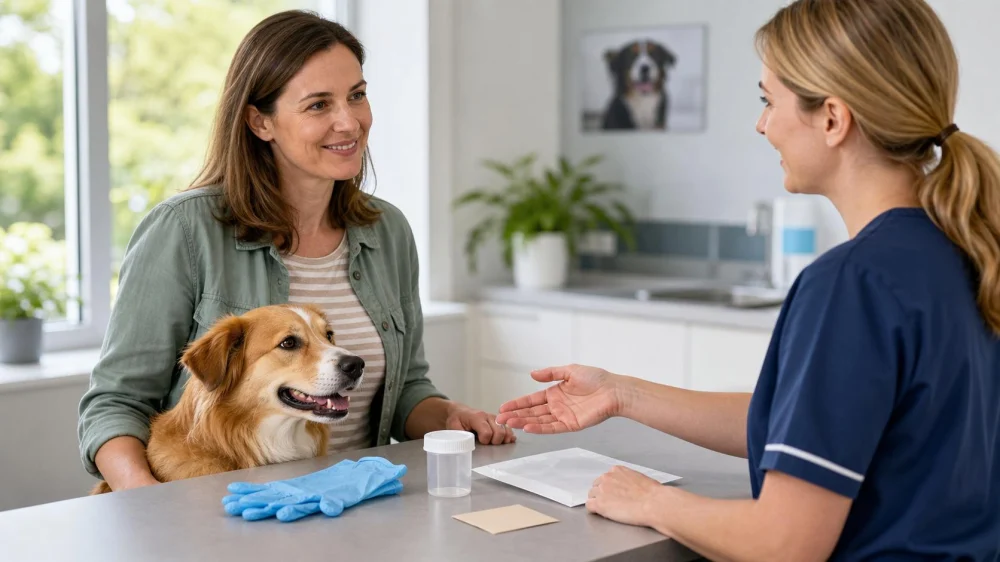
How to Collect a Pet Stool Sample for Your UK Vet
On this page
- Quick answer
- Why a vet may request a stool sample
- What to confirm before collecting
- Simple supplies to prepare
- How to collect the sample
- How much to collect
- How to label and store it
- Sampling in a multi-pet home
- Common mistakes to avoid
- When symptoms need prompt advice
- Frequently asked questions
- Conclusion and next steps
Quick answer
Collect a fresh stool sample in the clean, leak-proof container your veterinary practice recommends. Avoid soil, litter, disinfectant, and samples from another animal. Label it with your pet’s name and the collection date and time, then follow the clinic’s instructions for storage and delivery. If you cannot deliver it promptly, call before refrigerating, freezing, or discarding it.
This UK-focused guide supports preparation for a veterinary appointment; it does not diagnose diarrhoea, parasites, bleeding, or other digestive problems. Your practice’s instructions take priority because the required sample can depend on the planned test.
Why a vet may request a stool sample
A veterinary professional may ask for a faecal sample when investigating diarrhoea, changes in stool, possible parasites, weight loss, exposure to another unwell animal, or a recurring digestive problem. A sample may also form part of a checkup or monitoring plan.
Laboratories do not use every sample in the same way. The veterinarian may want to look for parasite eggs, infectious organisms, blood, inflammation, or another finding. That is why the clinic should tell you whether it needs one fresh sample, samples collected over several days, or a particular collection kit.
What to confirm before collecting
- Ask whether the practice wants a sample now or only after a consultation.
- Confirm whether one bowel movement is enough or whether several collections are required.
- Ask which container to use and whether the clinic supplies one.
- Confirm the latest acceptable delivery time and storage instructions.
- Tell the practice about current medicines, supplements, worming products, and recent travel.
- Ask what to do if the stool contains visible blood, a foreign object, or possible worms.
Do not stop prescribed treatment or give an extra worming product simply to prepare for testing unless the vet directs you to do so.
Simple supplies to prepare
The veterinary practice may provide a labelled specimen pot. If it does not, ask whether a new, clean, screw-top, leak-proof plastic container is acceptable. You may also need disposable gloves, a clean disposable scoop or spoon, a sealable outer bag, and a pen for labelling.
Keep the specimen container separate from food containers and household surfaces. Never reuse a pot that held chemicals, medicine, cleaning products, or food if the practice has not approved it.
How to collect the sample
- Prepare first: open the outer bag and have the labelled container and scoop ready.
- Observe the pet: make sure you know which animal passed the stool and note the approximate time.
- Collect promptly: take material before it becomes mixed with rainwater, soil, grass, cat litter, or another animal’s stool.
- Include useful variation: if the stool has an unusual soft, mucous, dark, or blood-streaked area, ask the clinic whether to include part of it.
- Seal carefully: close the lid firmly without contaminating the outside of the pot.
- Bag and clean: place the container in its outer bag, dispose of the scoop and gloves safely, and wash your hands with soap and water.
If collection would put you at risk of a bite, scratch, fall, traffic incident, or contact with an unknown animal, stop and ask the veterinary practice for another approach.
How much to collect
The right quantity depends on the test and container. A clinic may need only a small portion, while some investigations require more or repeated samples. Filling the container completely is usually unnecessary and can make it difficult to seal cleanly.
Ask for a simple description, such as the marked fill line or an approximate spoonful. If your pet produces only a tiny amount, do not assume it is unusable; bring or describe what you have and let the practice decide.
How to label and store it
Write the pet’s name, your surname, and the collection date and time on the container or clinic label. In a multi-pet household, add enough detail to identify the animal without doubt. Keep any request form with the outer bag rather than inside the specimen container.
Deliver the sample according to the practice’s timetable. Temperature and time can affect some results, so do not guess. Ask specifically whether it should remain at room temperature, be refrigerated in a separate sealed bag, or be collected again closer to the appointment. Do not freeze it unless the practice instructs you to.
Sampling in a multi-pet home
Separating pets briefly may help identify the correct sample, but do so only when it is safe and does not cause significant distress. For cats, a clean, empty tray or a non-absorbent collection material may be useful if the clinic approves it. For dogs, supervised lead walking can help you observe the bowel movement and collect it before contamination.
Never combine stools from different animals in one pot unless the veterinarian specifically requests a pooled sample. Record any uncertainty. A correctly labelled uncertain sample is more useful than a confident but incorrect identification.
Common mistakes to avoid
- bringing an old sample without telling the clinic when it was passed;
- allowing the sample to mix with soil, litter, water, or cleaning chemicals;
- using an unapproved or leaking container;
- leaving the pot unlabelled or confusing two pets’ samples;
- freezing, warming, or refrigerating it without checking instructions;
- assuming a normal-looking stool rules out a health problem;
- changing food or medication before the appointment without veterinary advice.
When symptoms need prompt advice
A sample is not a substitute for triage. Contact a veterinary practice promptly if your pet has repeated vomiting, frequent or severe diarrhoea, obvious blood, black or tar-like stool, marked pain, collapse, severe weakness, a swollen abdomen, suspected poisoning, or may have swallowed a foreign object. Very young, elderly, pregnant, or medically vulnerable animals may need earlier assessment.
If the pet is worsening, prioritise safe transport and veterinary advice over collecting the perfect sample. Tell the practice what you observed, when it started, what the pet has eaten, and whether other animals or people in the home are unwell.
Frequently asked questions
Can I collect a sample the night before?
Possibly, but only the practice can confirm whether its planned test accepts that timing and how the sample should be stored. Record the exact collection time.
What if cat litter sticks to the sample?
Do not rinse it. Collect the least contaminated part you can and tell the clinic what type of litter was present. It may ask for a fresh sample.
Should I photograph the stool as well?
A clear photograph may show colour, volume, or an unusual object that the collected portion does not capture. It complements a specimen but does not replace one when testing is requested.
Can I post the sample to a laboratory myself?
Use only the collection, packaging, and delivery route authorised by your veterinary practice or testing provider. Biological samples may have specific packaging and transport requirements.
Conclusion and next steps
Before collection, ask what container, quantity, timing, and storage the test requires. Label a fresh, uncontaminated sample clearly, seal it in an outer bag, wash your hands, and deliver it as directed. Keep a short symptom record as well, and contact the vet promptly if your pet is unwell rather than waiting for the planned appointment.
 Pasture Pet & Pond Supplies4.0 (188 reviews)
 Wilson Veterinary Group, Spennymoor4.0 (166 reviews)
 Canklow Meadows Cattery0.0 (0 reviews)
 Wings and Fins Pet and Aquatic Shop5.0 (4 reviews)
 Park Veterinary Group, Penarth4.0 (67 reviews)
 Vets for Pets - Kendal4.0 (134 reviews)
 UK Pet Owner’s Guide to Weight Management for Cats
 How to Improve Kittens Common Illnesses at Home
 Vet-Approved Exercise and Fitness for Senior Pets
 Flea and Tick Prevention for Pets in the UK
 How to Manage Your Pet’s Weight and Prevent Obesity: Expert Tips for Pet Owners
 Top 10 Seasonal Health Tips Every Reptile Owner in the UK Should Know