
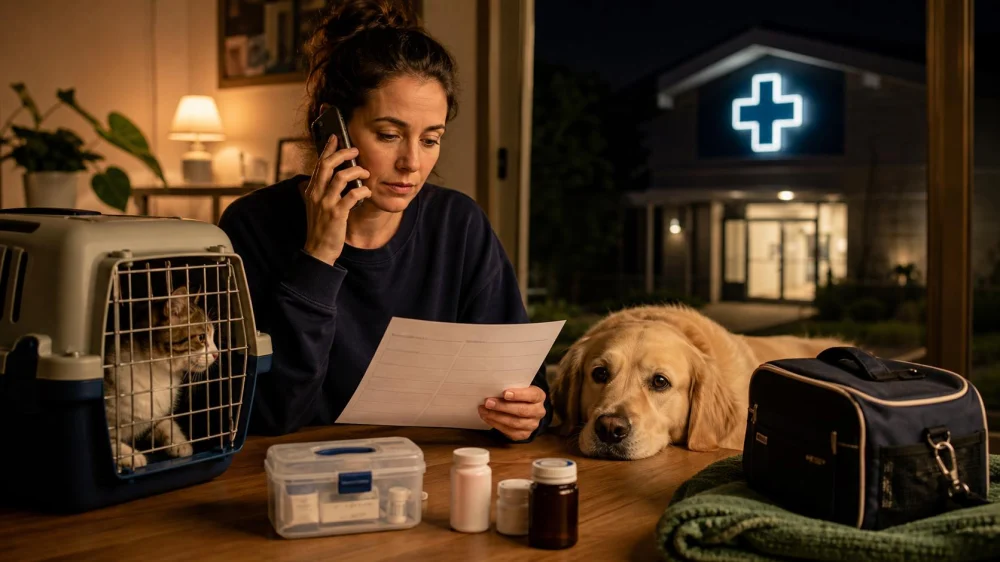
Calling an Out-of-Hours Vet: Prepare the Key Details
On this page
- Quick answer
- Find the correct emergency provider
- Lead with the urgent problem
- Collect a brief clinical history
- Follow transport instructions
- Understand out-of-hours arrangements
- Avoid dangerous delays and home treatment
- Limitations and important notes
- Sources and evidence notes
- Frequently asked questions
- Next steps
Quick answer
Call the veterinary practice’s emergency number promptly when your pet has breathing difficulty, collapse, severe bleeding, repeated seizures, major trauma, a swollen abdomen with distress, suspected poisoning, inability to urinate, or rapidly worsening pain. State the pet’s species, age, weight, exact symptoms, onset time, location, medicines, and possible exposure, then follow the clinician’s transport instructions. Do not give human medicine, induce vomiting, or travel to an unfamiliar site without confirming where the out-of-hours service is located.

Find the correct emergency provider
Save your registered practice’s daytime and out-of-hours numbers in your phone and on paper. The emergency service may operate from another clinic with a different address.
Check the practice website, voicemail, welcome pack, and premises notice before an emergency. RCVS states that every UK veterinary practice must provide 24-hour emergency first aid and pain relief, but delivery arrangements vary.
If you are away from home, call a nearby practice and explain that you are a visitor. Do not rely solely on map opening hours; confirm that the site is staffed and can treat the species.

Just For Pets Nuneaton
8 Horeston Grange Shopping Centre, Camborne Dr, Nuneaton CV11 6GU, UK
Lead with the urgent problem
Start the call with your location and the most serious observation, for example: “My dog collapsed five minutes ago and is struggling to breathe.” This helps the team triage while you provide details.
Emergency signs include:
- laboured, noisy, or absent breathing;
- collapse, unresponsiveness, or pale or blue gums;
- uncontrolled bleeding or major injury;
- repeated seizures or one prolonged seizure;
- repeated unproductive retching with a swollen abdomen;
- suspected toxin, foreign object, or medicine ingestion;
- straining without passing urine;
- severe eye injury, burn, or heat illness; or
- rapid deterioration or severe pain.
The list is not exhaustive. When unsure, call and let the veterinary professional triage.
Collect a brief clinical history
Have ready:
- pet’s name, species, breed, age, sex, neutering status, and approximate weight;
- exact symptoms, onset, frequency, and change over time;
- current medicines, doses, allergies, and major conditions;
- recent surgery, treatment, pregnancy, or nursing status;
- possible toxin or object, packaging, amount, and time;
- temperature only if safely measured with a vet-approved method;
- your current address, travel time, and transport options; and
- regular practice and insurance details.
A short video may help for intermittent breathing, gait, or seizure-like events, but film only when the pet and people are safe. Never delay the call to make a video.
Follow transport instructions
Ask for the exact address, entrance, parking instructions, phone-on-arrival procedure, and expected travel time. Confirm whether the team wants you to come immediately.
Use a secure carrier or lead appropriate to the animal. Injured animals may bite or scratch, so keep faces away and handle slowly. Do not muzzle an animal that is vomiting or struggling to breathe.
Bring medicine and toxin packaging, but place hazardous substances in a sealed secondary container. Bring veterinary records if accessible without delaying. Ask another adult to drive so someone can monitor the pet.
Understand out-of-hours arrangements
Out-of-hours care may be delivered by your practice, a partner hospital, or a dedicated emergency provider. Fees and payment processes can differ from daytime care. Ask about the consultation estimate and deposits, but do not postpone time-critical treatment while comparing prices.
Insurance may require later claim forms or contact, yet emergency clinical decisions should follow the animal’s needs. Keep invoices, clinical summaries, and medication instructions.
After initial first aid and pain relief, the vet should discuss findings, realistic prognosis, treatment options, referral, hospitalisation, transfer, or euthanasia where relevant.
Avoid dangerous delays and home treatment
- Do not give paracetamol, ibuprofen, aspirin, or another human medicine unless a vet specifically directs it for that pet.
- Do not induce vomiting unless instructed by a veterinary professional.
- Do not offer food or water when anaesthesia, obstruction, breathing difficulty, or severe vomiting may be involved unless advised.
- Do not wait for a normal appointment when breathing, consciousness, bleeding, urination, poisoning, or severe pain is affected.
- Do not post online and wait for replies instead of calling.
Limitations and important notes
This guide cannot triage an individual animal or replace a veterinary call. Species such as birds, reptiles, rabbits, rodents, fish, and farm animals may require specialist arrangements; confirm the provider can treat them.
If human safety is threatened by fire, traffic, electricity, chemicals, or an aggressive animal, contact emergency services and do not enter danger.
Sources and evidence notes
RCVS explains UK emergency and out-of-hours responsibilities, including accessible information about the practice’s emergency provision and 24-hour emergency first aid and pain relief.
- RCVS: Emergency and Out-of-Hours Care for Animal Owners
- RCVS: 24-Hour Emergency First Aid and Pain Relief
Frequently asked questions
Should I call before travelling?
Yes when possible. Confirm the correct staffed site and let the team prepare, unless human emergency services direct otherwise.
Will my usual vet be there?
Not necessarily. Practices may use a partner or dedicated emergency provider.
Can I give pain relief first?
Only medicine and dosing specifically directed for that pet by a veterinary professional.
Should I bring insurance details?
Bring them if readily available, but do not delay urgent care to locate paperwork.
What if I am unsure it is an emergency?
Call the veterinary service and describe the symptoms. Let a qualified professional triage.
Next steps
Save the out-of-hours number and address now, prepare a one-page pet medical summary, keep carriers accessible, and know your transport plan. During an emergency, call promptly, lead with the most serious sign, and follow the veterinary team’s instructions.






 Sandgate aquatics4.0 (60 reviews)
 Newcastle-Upon-Tyne PDSA Pet Hospital4.0 (933 reviews)
 Gladwells Pet & Country Store5.0 (5 reviews)
 PetBuds5.0 (2 reviews)
 Vets4Pets Peterborough Bretton4.0 (320 reviews)
 The Cinchy Doggie Bag0.0 (0 reviews)
 The Importance of Behaviour Training for Hamsters – UK Edition
 Why Is My Dog Not Eating? Causes, Symptoms & What to Do Next
 How to Safely Trim Your Dog’s Nails at Home – UK Guide
 The Importance of Exercise and Fitness for Hamsters – UK Edition
 What Are the Benefits of FIV Testing for Cats? UK Feline Immunodeficiency Guide
 Top 10 Common Illnesses Every Fish Owner in the UK Should Know for Healthy Aquariums