
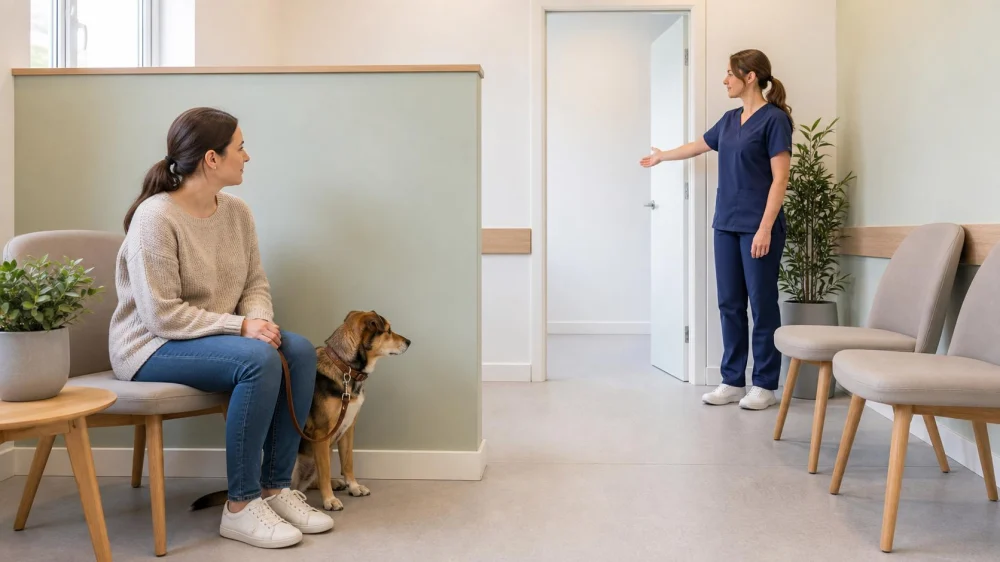
Vet Waiting Room Safety for Nervous or Reactive Pets
On this page
Quick answer
Tell the veterinary practice in advance that your pet is nervous, reactive or difficult around particular triggers. Ask whether you can check in by phone, wait outside or in a suitable vehicle, use a quieter entrance, or go directly to a consultation room. Keep dogs on secure equipment and cats or small pets inside closed carriers, with distance from others.
This UK guide uses “reactive” to describe a pet that may bark, lunge, freeze, hide, vocalise, struggle or otherwise respond strongly to people, animals or the clinic environment. It is not a diagnosis. Pain, illness and fear can change behaviour, so the veterinary team should know what you have observed and advise on individual handling.

Call the practice before arrival
Waiting-room safety starts before the appointment. A directory can help you compare listed hours, contact details, parking, accessibility and services, but call the practice to confirm its current layout and options.
Give reception a short, factual description:
- The species, size and secure transport method.
- The known trigger, such as unfamiliar dogs, cats, men, close handling, noise or confined spaces.
- What the pet does when worried: freezes, retreats, barks, lunges, scratches, bites, escapes or cannot settle.
- Any known bite, escape or equipment-failure history.
- Whether pain, illness or injury may be affecting behaviour.
- What has helped during previous visits.
Ask for a practical arrival plan. Possibilities can include the first or quietest appointment, checking in from outside, waiting in a suitable vehicle when weather and supervision make that safe, using a side entrance, or moving directly to a room. Not every practice can offer every option, and emergencies can change the schedule.
Do not arrive with an unexpected sedative or calming medicine. If pre-visit medication may be appropriate, the vet must decide what, when and whether it is safe for that individual pet. Use only the prescribed dose and instructions.

Archway Veterinary Practice
HowdenEast Riding of YorkshireEngland
White Horse, Market Pl, Howden, Goole DN14 7BJ, UK
Arrive with secure physical control
Check collars, harnesses, leads, carrier doors, latches, zips and handles at home. A frightened animal can exploit a gap that seems harmless during a calm practice session.
For cats and small animals, use a sturdy, closed, ventilated carrier appropriate to the species. Keep the door shut in the car park and waiting room. Support the carrier level from underneath and avoid placing it on the ground where dogs can approach.
For dogs, use secure, well-fitting restraint equipment that the dog already knows. Avoid retractable leads in a crowded clinical space because they make distance harder to control. Keep the lead short enough to prevent approaches without holding continuous tight pressure that increases tension.
If a basket muzzle is part of the dog's established safety plan, check the fit and bring it. Do not introduce an unfamiliar tight muzzle in the car park unless the veterinary team directs an emergency method. A muzzle reduces bite risk but does not make forced greetings or unsafe proximity acceptable.
Bring only what you can manage safely: records, medication and questions in one bag, treats approved for the pet when permitted, spare carrier bedding, and waste bags. Avoid juggling a loose phone, coffee, paperwork and an animal at the doorway.
Use space, barriers and quiet positioning
Pause before entering and scan through the door or window. If another animal is close to the entrance, wait at a safe distance and call reception. Do not squeeze past because the appointment time has arrived.
Inside the waiting area:
- Choose the quietest available position with a clear route to the consultation room and exit.
- Use a solid chair, partition or reception desk as a visual barrier when appropriate.
- Keep dogs beside or behind you rather than at the end of a lead in the central aisle.
- Place a cat carrier on a stable raised surface if the practice provides one.
- Keep separate carriers apart and prevent dogs from sniffing carrier doors.
- Ask people not to touch, stare at or approach your pet.
- Reduce conversation and phone noise while watching the pet's body language.
For some cats, a familiar light towel over part of the carrier can reduce visual stimulation, provided airflow remains open and temperature is monitored. Cats Protection recommends keeping the carrier closed and, when a waiting room is too stressful, asking reception whether waiting in the car until called is possible. See its lower-stress vet visit guidance.
Watch for escalating stress rather than waiting for a lunge or escape attempt. Early signs vary by species and individual but can include fixed staring, repeated scanning, inability to take a familiar treat, trembling, crouching, rapid panting unrelated to heat, hiding, growling, hissing, swatting, barking or repeated attempts to retreat.
If stress rises, increase distance and notify staff. Do not punish warning behaviour; it communicates that the animal needs space. Do not let another owner conduct a “quick greeting” to test whether the animals will settle.
Coordinate the move into consultation
Wait for staff to confirm that the route and room are clear. One person should manage the animal while another opens doors when help is available. Avoid a cluster of people leaning over a carrier or reaching for a dog's collar.
Give the clinician a concise behaviour handover before close contact:
- State the most likely trigger and the earliest warning sign.
- Describe previous bite, scratch, escape or restraint incidents factually.
- Explain what handling the pet usually accepts.
- Mention pain, medication, food restrictions and any change since booking.
- Ask what role you should take during examination.
Leave a cat inside the carrier until the veterinary team is ready. A removable top may allow part of an examination with less forced extraction, but staff should decide the method. Do not tip or shake an animal out.
For a dog, follow the clinician's positioning instructions and do not hold the head or force a body part unless asked and you can do so safely. Owners can unintentionally block a retreat or put their face near a frightened dog. The team may change the examination plan, use additional trained staff, pause, reschedule non-urgent work or discuss medication.
Plan the exit and future visits
Before opening the consultation-room door, ask whether the waiting area and exit path are clear. Secure the carrier or lead first, gather belongings second, and leave in a controlled sequence.
Do not stop in a narrow doorway to schedule or pay if your pet is struggling. Ask whether the practice can complete payment in the room, by phone or through another method and book follow-up after the animal is safely settled.
Once home, record what worked and what did not: time of day, entrance, waiting location, distance, carrier cover, treats, staff approach, handling, medication and recovery time. Share useful details before the next visit.
For ongoing severe fear or aggression, ask the vet about a structured plan. Medical causes should be considered before behaviour is treated as a training issue. The vet may recommend gradual cooperative-care work or referral to a suitably qualified behaviour professional.
Important limits and urgent care
Do not delay urgent veterinary care because a waiting room is difficult. Call ahead, describe both the medical problem and handling risk, and follow the practice's immediate instructions. An emergency service may be at another site.
Never leave a pet unattended in a vehicle. Waiting in a vehicle is not suitable when temperature, breathing, illness, distress, parking safety or supervision creates risk. Ask for a different arrangement.
Do not use punishment, choke, shock or improvised restraint to suppress visible behaviour. Do not give human medicine or another animal's prescription. If equipment fails or the animal escapes, avoid chasing into traffic; alert the practice and use its emergency containment guidance.
Frequently asked questions
Should I tell the clinic my dog has bitten before?
Yes. Give factual information about what happened, the trigger, injury, warning signs and current management. The purpose is safer planning, not blame. Withholding it can put the pet, owner, staff and others at risk.
Can I wait in the car with my cat?
Ask the practice. It can reduce exposure to a busy waiting room when the vehicle remains safe, supervised and at a comfortable temperature. Never leave the cat unattended, especially in warm weather.
Should other dogs greet my nervous dog?
No. A veterinary waiting room is not the place for introductions. Maintain distance and politely ask owners to call their dog back. Use staff help if the route is blocked.
Does a muzzle mean a dog is safe to approach?
No. A muzzle is one safety layer and does not remove fear, stress or the need for space. Only use a suitable, familiar muzzle under an established plan or veterinary direction.
What if my pet cannot be examined?
The veterinary team may adapt the environment or handling, prioritise urgent checks, pause, use medication, or reschedule non-urgent work. Ask for a written plan before the next attempt.
Sources and evidence notes
The cat waiting-room practices align with Cats Protection guidance to keep cats in secure carriers, use distance and familiar covers with ventilation, and ask about waiting outside when appropriate. Behaviour and medical needs vary, so the veterinary team's plan takes priority. This article does not diagnose anxiety or aggression.
Conclusion and next steps
A safer vet visit for a nervous or reactive pet depends on advance information, secure equipment, distance and coordinated movement. Call before arrival, agree where to wait, prevent greetings, watch for early stress and let staff control the route into the room. Afterward, record what helped and build the next visit around those facts. When care is urgent, call ahead and follow the emergency team's instructions without delay.




 HD1 Aquatics and exotic pets4.0 (640 reviews)
 Pets at Home Guiseley4.0 (236 reviews)
 Natural world pet store4.0 (794 reviews)
 Andrew Mellor Veterinary Surgeons4.0 (434 reviews)
 easipetcare - Kettering4.0 (402 reviews)
 Lisnafillan Farm Vets5.0 (2 reviews)
 UK Pet Owner's Guide to Spaying and Neutering for Kittens
 Expert Vet Advice on Nutrition Tips for Fish
 Mental Health Explained: Keeping Your Senior Pets Healthy in the UK
 How to Deal with Anxiety and Stress in Pets: Expert Vet Advice
 How to Spot Signs of Arthritis in Older Pets – UK Pet Owner’s Guide
 Top 10 Seasonal Health Tips Every Senior Pet Owner in the UK Should Know