
Pet Carrier Checklist for a Safer UK Vet Visit
On this page
- Quick answer
- Choose the right carrier or restraint
- Inspect and prepare the carrier
- Help your pet become familiar with it
- A practical travel-day sequence
- At the practice and on the return journey
- Important limits and professional advice
- Frequently asked questions
- Sources and evidence notes
- Conclusion and next steps
Quick answer
Use a sturdy, secure, ventilated carrier that lets the pet stand, turn and lie naturally without sliding around. Check every latch, line it with absorbent and familiar bedding, introduce it well before the appointment, and restrain it in the vehicle. Call the vet for species-specific advice, severe travel stress, illness, injury or medication questions.
This UK guide is mainly for cats and small companion animals travelling to a veterinary practice. Dogs may need a suitable vehicle crate, seat-belt harness or dog guard rather than a handheld carrier. Birds, rabbits, reptiles and other species have different temperature, companion and enclosure needs, so ask the veterinary team what is suitable.

Choose the right carrier or restraint
A pet carrier is a secure, ventilated enclosure designed to contain and protect an animal during handling and transport. It should prevent escape without trapping the animal in an unstable, cramped or poorly ventilated space.
Before buying or borrowing one, compare:
- Size: The pet should be able to stand at full height, turn around and lie in a natural position. An oversized space can allow sliding during braking, while a cramped space can restrict movement and airflow.
- Strength: The base, sides, roof, handle and fixings should support the pet's weight without bending or separating.
- Ventilation: Openings on multiple sides support airflow, but gaps must not allow the pet to squeeze out or catch a limb.
- Access: A front door plus a top opening or removable top can make calm placement and veterinary access easier for some cats.
- Cleaning: Smooth, water-resistant surfaces and removable bedding are easier to clean after urine, faeces, vomit or medication spills.
- Security: Doors and latches should close positively and resist being pushed open. Check that screws and clips cannot loosen.
- Vehicle restraint: The design should allow stable placement and secure restraint according to its instructions and the vehicle setup.
Cardboard carriers can weaken when wet and may not suit repeated transport. Soft carriers vary widely in structure, ventilation and zip security. Backpack designs may not give every cat enough room to reposition. Select for the individual animal and journey, not appearance alone.
For a dog too large for a handheld carrier, ask what suitable restraint works with the dog's size, the vehicle and the journey. The UK Highway Code Rule 57 says dogs and other animals should be suitably restrained so they cannot distract the driver or injure themselves or others if the vehicle stops quickly.

Vets4Pets - Belfast
Unit 5, Inside Pets at Home, Balmoral Plaza, Boucher Rd, Belfast BT12 6HR, UK
Inspect and prepare the carrier
Do a physical check several days before the appointment, not as the taxi or car arrives.
- Place the empty carrier on the floor and press gently on the base, sides and roof.
- Lift it by the handle while supporting the base; look for flexing, cracks or separation.
- Open and close every door and latch several times.
- Check screws, clips, zips, seams and ventilation holes for sharp edges or damage.
- Confirm an identification tag does not create a snag or escape risk.
- Clean with a pet-safe method, rinse when required and let it dry fully.
- Add a non-slip absorbent layer and a familiar washable towel or blanket.
- Pack spare bedding, waste bags and cleaning supplies separately.
Do not add loose bowls, hard toys or heavy objects that could strike the pet during movement. A familiar soft item may help, but it must not block ventilation or create overheating. If a towel is placed over part of a cat carrier to reduce visual stimulation, keep airflow clear and monitor temperature.
For two animals, use separate carriers unless a vet or species-specific professional advises otherwise. Even bonded animals can react unpredictably when frightened, painful or confined. Some small social species have different companion needs, so seek tailored advice rather than applying the cat rule automatically.
Help your pet become familiar with it
A carrier that appears only before a vet visit can become a warning signal. Leave it open in a quiet living area well before travel, with the door secured so it cannot swing. Allow the pet to investigate voluntarily.
Build familiarity in small steps:
- Place familiar bedding near the carrier, then inside it.
- Offer food or suitable treats near the entrance and gradually farther inside if the pet remains comfortable.
- Practise closing the door briefly, then reopen it before distress escalates.
- Lift the carrier a short distance while supporting it level.
- Practise sitting in a stationary vehicle, then a very short journey when appropriate.
- Reward calm behaviour and stop before the exercise becomes overwhelming.
Never chase, punish or force repeated attempts as routine training. If the animal cannot be safely placed inside, has previously injured itself, becomes extremely distressed, or requires an urgent visit, call the veterinary practice. The team can give handling and appointment advice appropriate to the animal and urgency.
Do not give a human sedative, leftover veterinary medicine or non-prescribed calming product. If medication might be appropriate for travel, it should be discussed with the vet in advance and used exactly as directed.
A practical travel-day sequence
Confirm the practice address, parking or taxi drop-off point, appointment time and contact number. Ask whether you should wait in the vehicle or use a quieter entrance if your pet is reactive, frightened or vulnerable.
- Secure the room. Close external doors, windows and cat flaps before opening the carrier. Keep other pets away.
- Prepare supplies. Put records, medication, samples and payment items in a separate bag so the carrier stays level and your hands remain available.
- Place the pet calmly. Use the practised method. Support the carrier from underneath rather than swinging it by the handle.
- Check every closure. Gently test the door, latches and zips before leaving the secure room.
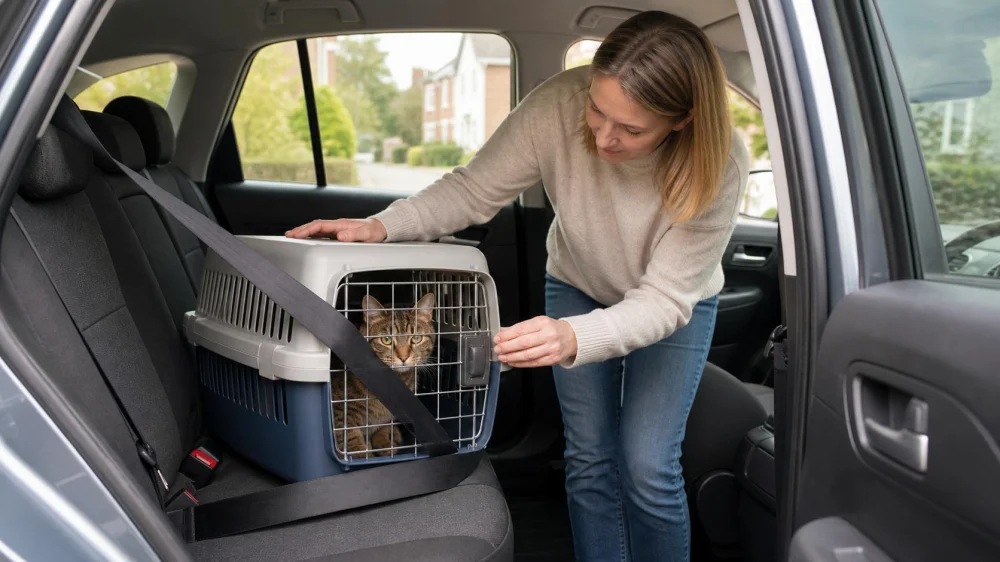
- Restrain in the vehicle. Keep the carrier upright and stable using the manufacturer's guidance and a suitable vehicle position. A loose carrier can move during a sudden stop.
- Control the environment. Drive smoothly, keep sound low and maintain comfortable ventilation. Do not direct strong heating or air conditioning at the animal.
- Keep the pet contained. Do not open the carrier in a car park, beside a road or inside an unsecured vehicle.
Cats Protection recommends keeping a cat inside the carrier throughout car travel and securing the carrier, commonly on the back seat with a seat belt when suitable for the carrier and car. Its cat travel guidance also recommends gradual introduction to journeys.
Never leave a pet unattended in a vehicle, particularly in warm conditions. Vehicle temperatures can become dangerous quickly. If travel is delayed or the pet develops concerning symptoms, stop safely and call the vet.
At the practice and on the return journey
Keep the carrier raised and supported rather than placing it where dogs can approach or where it can be kicked. Follow the practice's waiting instructions. Tell reception if the animal's condition has changed, if it is highly distressed, or if an escape risk requires a quieter route.
Do not open the carrier in the waiting room unless staff directs you in a secure space. Some examinations can begin with a removable carrier top or while familiar bedding remains around the animal, but the veterinary team should decide the safe method.
Before leaving, confirm any feeding, medication, monitoring or transport instructions. An animal recovering from sedation, anaesthesia, injury or a procedure may need a different carrier setup and closer observation. Ask who to call if problems develop during the journey home.
After returning to a secure room, let the animal exit at its own pace when the vet has not given different instructions. Clean soiling promptly with a pet-safe method, rinse as appropriate and dry the carrier. Then leave it accessible again so it does not disappear until the next stressful visit.
Important limits and professional advice
Do not delay urgent veterinary care to complete carrier training. Call ahead so the practice can prepare and advise on immediate safe transport. An injured or painful animal may bite, scratch or struggle even when normally gentle.
Seek veterinary advice before travel for breathing difficulty, collapse, uncontrolled bleeding, major trauma, repeated vomiting, severe distress, inability to stand or another urgent concern. Animals with heart or breathing disease, pregnancy, extreme age, temperature sensitivity or recent surgery may need specific arrangements.
Public transport, taxis, ferries and airlines have separate pet and carrier rules. Confirm them directly. International travel also requires current legal documentation and approved transport arrangements beyond this local vet-visit checklist.
Frequently asked questions
How large should a cat carrier be?
It should allow the cat to stand, turn and lie naturally, while remaining stable enough to limit sliding. Measure the cat and follow the carrier manufacturer's size and weight limits.
Should I cover the carrier?
A light familiar towel may reduce visual stimulation for some cats, but it must not block ventilation or cause overheating. Monitor the animal and remove it if distress or temperature becomes a concern.
Can two cats share one carrier?
Separate carriers are generally safer because stress or pain can change behaviour and one animal can block the other's movement or airflow. Ask the vet about any exceptional circumstance.
Where should the carrier go in a car?
Use a stable, suitably restrained position that works with the carrier and vehicle instructions. The Highway Code requires suitable restraint so an animal cannot distract the driver or be injured during sudden stopping.
What if my pet panics when the carrier appears?
Leave the carrier out between visits and use gradual positive familiarisation. If travel is soon, distress is severe or safe handling is not possible, call the veterinary practice rather than improvising medication or force.
Sources and evidence notes
The vehicle-restraint boundary comes from the UK Highway Code. Carrier selection and cat travel practices align with Cats Protection and broad RSPCA animal-transport guidance. Species, illness, injury, vehicle and carrier design can change what is safe, so veterinary and manufacturer instructions take priority.
Conclusion and next steps
Prepare a suitable pet carrier before it becomes urgent: check fit, strength, ventilation, access, cleaning and vehicle restraint, then build calm familiarity over time. Before the appointment, confirm the practice route and any species-specific instructions. On travel day, keep the pet contained, the carrier stable and the environment calm. When illness, injury or severe distress changes the situation, call the vet for an individual plan.






 HD1 Aquatics and exotic pets4.0 (640 reviews)
 Pets at Home Guiseley4.0 (236 reviews)
 Natural world pet store4.0 (794 reviews)
 Andrew Mellor Veterinary Surgeons4.0 (434 reviews)
 easipetcare - Kettering4.0 (402 reviews)
 Lisnafillan Farm Vets5.0 (2 reviews)
 UK Pet Owner's Guide to Spaying and Neutering for Kittens
 Expert Vet Advice on Nutrition Tips for Fish
 Mental Health Explained: Keeping Your Senior Pets Healthy in the UK
 How to Deal with Anxiety and Stress in Pets: Expert Vet Advice
 How to Spot Signs of Arthritis in Older Pets – UK Pet Owner’s Guide
 Top 10 Seasonal Health Tips Every Senior Pet Owner in the UK Should Know